Growing Too Fast to Track Stock? Shopify Stock Management: Expanding Ecommerce Store Guide
A high growth rate is the desire of every e-commerce business owner, but it also comes with a lot of confusion in stock tracking. For example, first and foremost is manual data entry, which is the core reason so many errors occur. Then comes the multichannel selling pitfall, overselling during peak duration, and spreadsheet failures.
Shopify stock management for growing ecommerce stores setups turn this chaos into smooth, scalable operations, keeping your expanding business ahead of the curve.
Smart Stock Management Solutions for Manual Inventory Challenges
A manual stock check is a nightmare when your online store starts booming. Orders are received at a rate that you cannot fill up the inventory with and therefore causes overselling or stockouts that will anger the customers and damage your brand.
Suppose one loses sales due to a popular item appearing online and being out of stock in the warehouse. Minimal teams lose hours in the process of reconciliation among platforms, which postpones shipment and creates more errors.
This is heightened by the busy holidays, causing disappointed buyers and negative reviews due to the last-minute rush. In an absence of the appropriate systems, expanding stores experience the problem of cash flow due to the accumulation of the unsold items somewhere.
Limitations of Startup Tools at Scale
The growth of e-commerce outsmarts simple startup tools. Simple arrangements are good with 50 orders per day, but with 500 orders per day, spreadsheets cannot handle the load.
Several different sales platforms such as WooCommerce, Etsy, or social media draw on the same inventory, and this introduces sync gaps. The manual entry exposes mistakes to humans such as entering incorrect figures during rush hours.
In the case of seasonal spikes or viral products, automation is not offered. Most brands do not pay much attention to scaling in the first place and continue using free apps, which limit them; then they have to make rushed and expensive changes.
Real Time Control with Shopify Apps
Enter Shopify inventory management for developing e-commerce stores that process a high volume with ease. With the help of smart apps on top of its native capabilities, Shopify will provide you with real-time visibility and control.
These systems bridge your whole operation, and stock is current in all channels in real time. There is no longer any guesswork; check the precise levels, forecast shortages, and make real-time adjustments.
In the case of scaling brands, this is credible delivery to create customer confidence. Modernize now to be ahead of growing pains.
Shopify Stock Management Setup for Scaling Brand
First Dashboard Setup
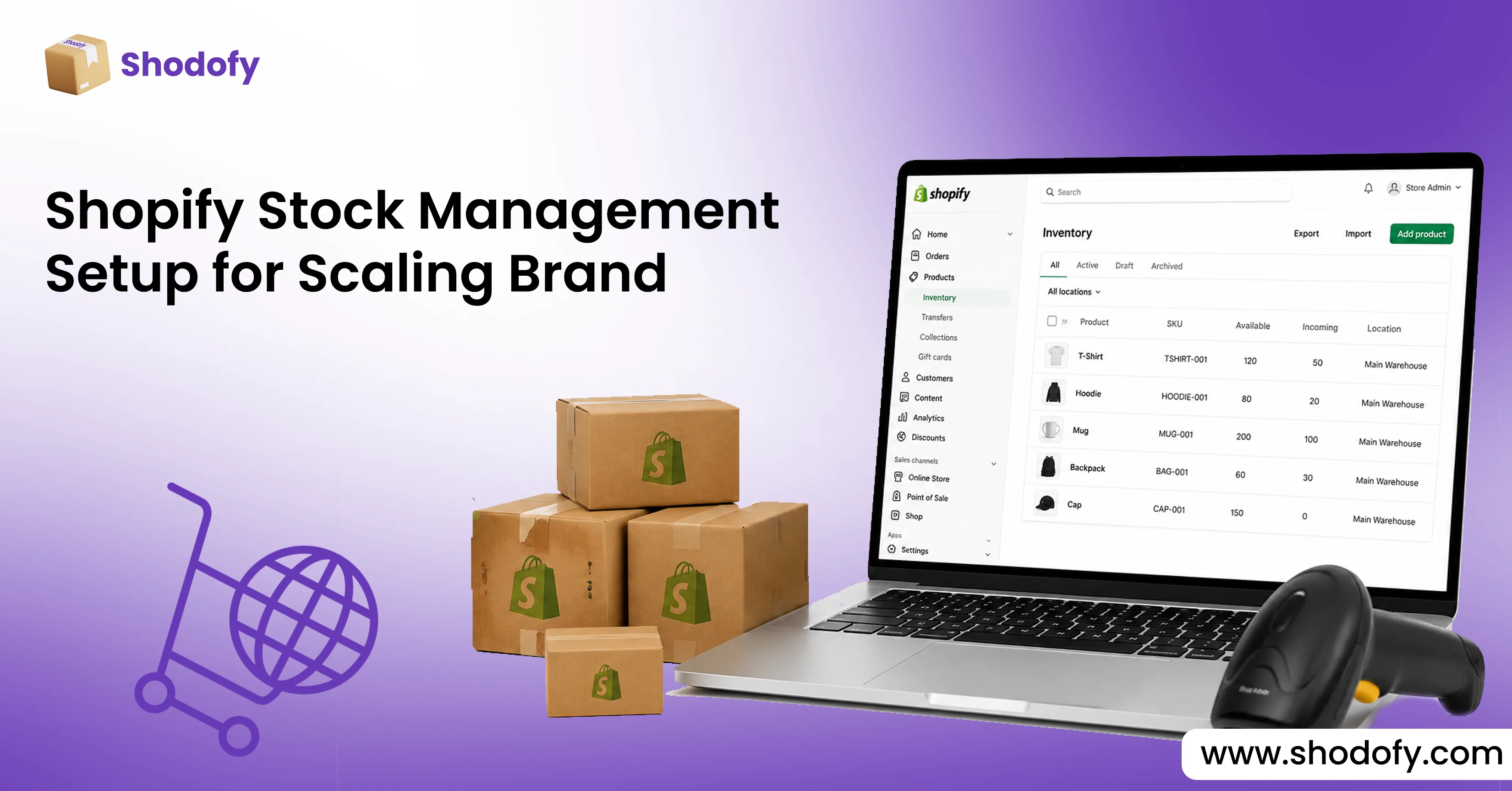
Begin with your Shopify dashboard. Enter products and inventory, turn on tracking of all items, and establish a reorder point depending on the speed of sales.
Here the setup of Shopify stock management to scale a brand starts with the assignment of locations such as warehouses or dropship partners and then connects SKUs correctly.
Add applications such as Stocky or TradeGecko into the Shopify App Store. These do the ABC analysis and segregate fast-movers to do priority restocks.
Eliminate manual tasks through Automation
Then, integrate with Shopify to automatically update stock and do not make it manually. Get suppliers through APIs to live feeds; programs such as Stock Sync retrieve data every 15 minutes.
Fixed policies: Purchase orders are automatically generated by low stock emails. Push the updates to Facebook Shops or Google Shopping instantly with the help of webhooks.
Test on a small batch, make dummy orders, and monitor real-time sync. This reduces daily workload by 80 percent and liberates your staff to do marketing.
Centralized Stock Management to gain Better Control
Build centralized stock management of an expanding e-commerce store through the integration of all channels. Such applications as Dear Inventory serve as a center, following the multi-warehouse inventory in a single display.
Allow the tracking of kits and subtract components automatically when a set is sold. Predict demand using sales history; the analytics of Shopify forecast the trends between 30 to 90 days.
Conduct weekly audits: export reports to CSV, identify any discrepancies, and make changes to safety stock levels. This arrangement makes it millions in revenue without hiring.
Key Benefits of Automation in Stock Management Systems
Real-Time Accuracy:Again, not to oversell, consumers receive real availability, and completion rates will be increased by 25 percent.
Time Savings:Automating stock updates in Shopify would not only save time on inventory checks that could take hours a day but also reduce them to minutes a day.
Cost Control:A growing e-commerce store is centrally controlled on stock to avoid the overbuying that holds less cash in dead stock.
Scalability:The Shopify inventory management system scales to brand growth; if there is no scaling, load your 10x sales and replace them at 10x.
Customer Wins:4.8+ star ratings and repeat purchases will be the result of faster shipping on correct stock.
Decisions Data-Driven:According to reports, the best sellers are made available; change the assortment to earn twice the profit.

Proven Success Stories
Consider Thread Republic, a fashion brand that has reached 300 percent growth. To expand e-commerce store applications with Shopify stock management, they synchronized three warehouses, resulting in a reduction to 90% of stockouts during Black Friday.
In a mini case study, an electronic store located in California experienced an issue of overselling smartphones. Replacing the manual sync with an automated one solved that, with 98 percent of the orders met in time, sales increased by 40 percent the following quarter.
Practical hint: It is a good habit to label the products with specific fields that would be automatically alerted during the expiry date, such as "seasonal."
Beyond High-Volume Operations: Smarter Stock Management
Layered on bundle management: Shopify apps follow nested inventory, thus selling a gift set reduces each item appropriately.
Connect with accounting software such as QuickBooks to track costs. Go with low-stock levels dependent on lead times; reorder at 2 weeks of supply.
In case of multi-location, transfer orders are enabled:stock can be transferred to hot warehouses with a single click.
Dashboards/monitors and custom reports display turnover ratios. Target 4-6x a year to maintain cash flow.

Errors That Limits Development
A lapse in SKU standardization results in duplication; it should be audited every quarter.
Exceed the use of free features and upgrade applications when needed.
Disregard access to mobile: select applications with good phone applications to check on the floor.
To be able to expand globally, consider factoring duties to stock valuation to get actual profitability.

Conclusion: Why Smart Stock Management Matters
Expanding e-commerce requires intelligent technology, and Shopify inventory management of expanding e-commerce companies provides the same. These measures will ensure that growth embroiled is transformed into a smooth success.
Your brand warrants the tools that suit its aim, begin your Shopify inventory control establishment to scale your brand now.