Centralized e-commerce operations: the hidden reasons why brands struggle to scale their businesses.
The centralized ecommerce operations have become one of the major deciding factors between all the brands, which also scales in profitability, and those that collapse under all kinds of complexity. As the e-commerce brands grow, many leaders discover that all the revenues bring as many different challenges as the rewards. Some of the orders that are pouring in from multiple different channels, inventory spreads across different channels and locations, and all kinds of financial data get lost between all the tools. Without centralized operations, the systems are what they once also felt like, and progress soon turns into daily chaos.
Many founders think they are facing these issues because of marketing or staffing issues, but in reality, it's an operational issue. When the systems are also staying disconnected, teams lose time, visibility, and controls- and 75% of scaling brands eventually fail because of it. Shodofy provides a centralized operations platform for ecommerce store owners and businesses.
Some of the real reasons scaling brands also lose their control
Many different DTCs and all the omnichannel founders build their tech stack gradually. It also starts with Shopify for sales, QuickBooks for all the accounting, and maybe a warehouse tool for all the fulfillment. Initially, this patchwork works fine. But as volumes double or new channels open, cracks appear everywhere.
For example, finance can't close the books on time because the order data from Shopify also doesn't match accounting numbers. The warehouse teams also ship the wrong kind of SKUs because inventory sync lags by 24 hours. Meanwhile, customer service handles angry emails, while you also spend Monday morning solving what software should have handled automatically.
These recurring issues also happen for one reason: your operations are also scattered across too many different kinds of systems. Every new app adds one more layer of fragmentation. Consequently, your business slows down even as sales go up.
Centralizing ecommerce operations replaces that chaos with clarity. Instead of just managing dozens of data points, you also operate from a single dashboard that shows orders, stocks, and margins in one place. Therefore, decisions also become faster, teams align, and growth becomes very sustainable.
Focus on growth, not only firefighting.
Every founder or COO shares the same kind of core goals to spend more time on all the growth and less on daily firefighting.
When operations are centralized, that goal becomes realistic. You also gain full visibility into your supply chain, finances, and fulfillment performances. In addition, your teams also stop reacting and start planning.

With all the centralized ecommerce operations, you can:
- View all the order data in real time across all Shopify and wholesale.
- When tracking accurate inventory and forecasting demand confidently
- Close books faster and understand all the margins without any kind of manual checks.
- Reducing all the human errors, delays, and duplicated work.
Ultimately, this clarity gives you all the freedom to focus on strategic growth, partnerships, and brand building, not spreadsheets and Slack threads.
The hidden frictions behind fragmented operations-When the systems stay disconnected, friction accumulates invisibly across departments. Over time, this friction translates directly into lost profit.
Some of the five most common operational breakdowns:
- Data fragmentations: the sales, stocks, and all kinds of accounting systems don't share updates.
- Manual reconciliations: the teams copy data manually, creating all the risk and fatigue.
- Lack of real-time visibility: the decisions depend on outdated reports.
- Scaling bottlenecks: each kind of new channel or warehouse adds exponential complexity.
- Inaccurate financials: the delayed COGS and misaligned revenues are distorting the cash flow.
Because of these frictions, most brands don't notice the impact until margins shrink or customers churn. Therefore, centralizing your operations early prevents both wasted efforts and growth stalls later.
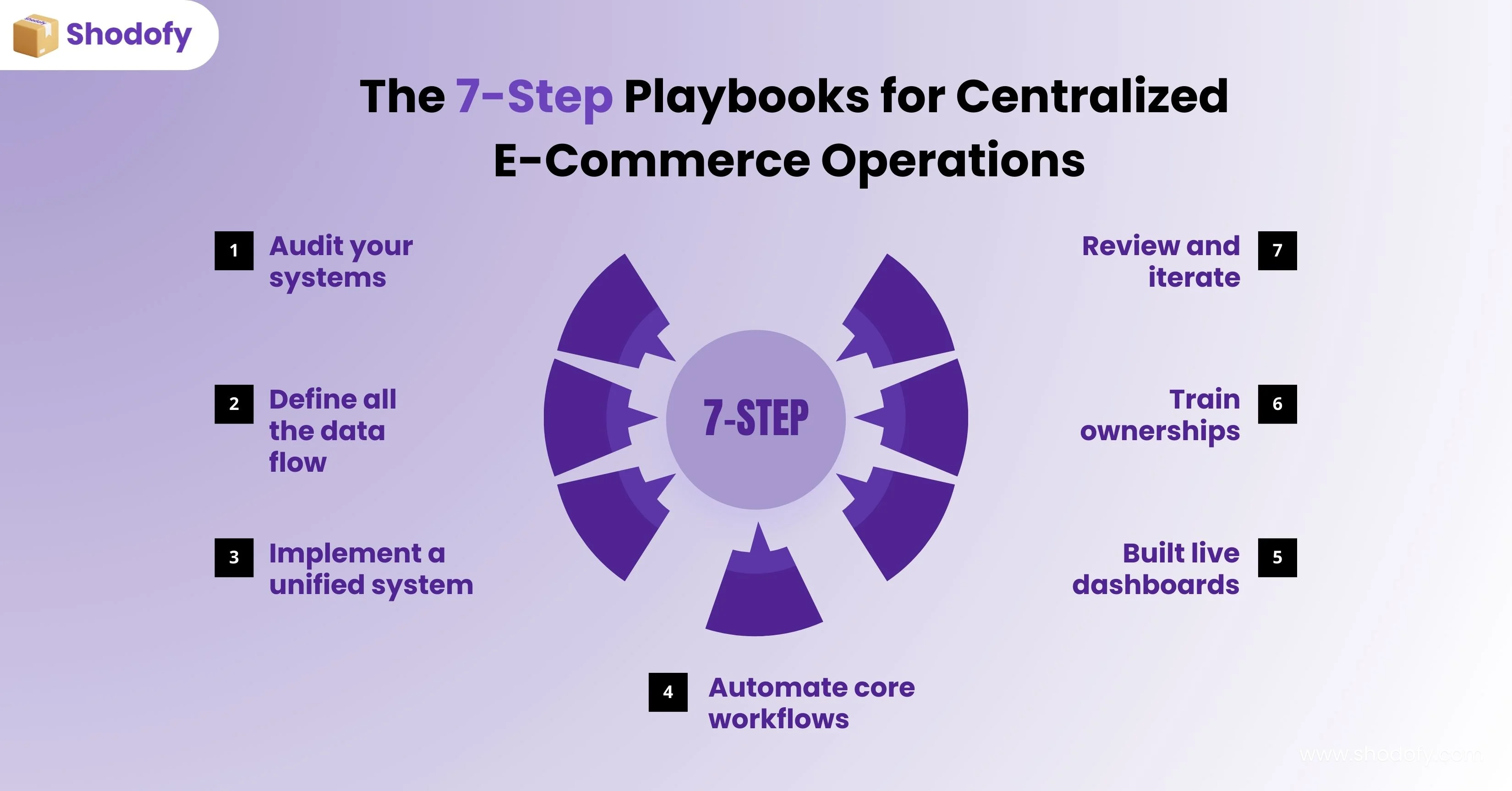
The 7-Step Playbooks for Centralized E-Commerce Operations
When implementing centralized operations doesn't have to be overwhelming. In fact, most successful DTC brands follow a predictable seven-step path.
1. Audit your systems
When you start by mapping every platform that also touches every kind of orders, inventory, and even its accounting, identify all the overlaps, redundancies, and all kinds of manual handoffs.
Goal: understanding all the operational realities
metric: reducing all the manual tasks by at least 70%
2. Define all the data flow
Next, outline how data should move from the order creation to all kinds of cash recognitions. This will also reveal where delays or even errors occur.
Goal: achieving all the transparency in your order to even the cash lifecycle
metric: reconciliation time per order under five minutes
3. Implement a unified system
At this stage, introducing all the modern e-commerce ERP systems, which can also centralize your backend. The solution, such as Shopify, helps you to connect your store, warehouse, and accounting seamlessly.
Goal: eliminating all the system silos
metric: to ship cycles within 24 hours
4. Automate core workflows
The automated COGS calculations, stock updates, and journal entries. As a result, your finance and ops teams will work from all the same live data.
Goal: end lag between sales and finance data
metric: month-end close within three days
5. Built live dashboards
Instead of just spreadsheets, build dynamic dashboards that also update in real time. Consequently, every team member also sees accurate numbers all the time.
Goal: replace reactive reporting with all the proactive insights
metric: zero manual report preparations
6. Train ownerships
The centralization works best when everyone owns part of it. Therefore assigns clear KPI owners inside your ERP
Goal: empower teams to manage data-driven results
metric: reducing all the operational fire drills by 80%.
7. Review and iterate
Finally, set quarterly reviews to adjust workflows and maintain accuracy as the volume grows.
Goal: keep operations aligned with the scaling demands
metric: maintain 99% inventory accuracy
Real-world examples for all the transformations
When considering a $12M oputdoor, gear brands that relied on four disconnected tools: Shopify, Magento, and even WooCommerce. At first, it also worked well enough. However, as the orders scaled, reconciliations took almost 12 hours a week, and inventory variance hit 9%.
After implementing centralized e-commerce operations through Shopify, everything changed within one quarter. Orders, stock, and finances synced automatically. Reconciliations time dropped from 12 hours to just one hour. Inventory variance fell to 0.8%, and the team gained nearly two full working days weekly.
The Measurable Payoff of Centralized Ecommerce Operations:
- Once operations are centralized, you'll notice measurable improvements within the first month.
- Order accuracy increases because stock data is always current.
- Cash conversions improve since accounting is synchronized with sales.
- Cycle times shorten because every workflow is automated end-to-end.
- Team morale rises since people spend time on strategy, not cleanup.
As a result, your brand becomes more scalable and resilient. Instead of reacting to problems, your teams can proactively plan the next phase of growth.

What the Future Looks Like After Centralization
Imagine starting Monday with a single dashboard showing everything that also matters, orders processed, cash collected, and even inventory ready for all the sales. You don't even need to ask for three people or even download five reports. Therefore, your focus shifts from fixing issues to creating opportunities.
If your brand is scaling fast and you're ready to even simplify your systems, start by Shodofy because it is one of the best centralized operations platform for eCommerce business.